
India’s journey toward becoming a global economic powerhouse is being driven by several states, but none tell a more fascinating story than Tamil Nadu and Uttar Pradesh. These two states represent very different paths to development, yet both are now among the country’s most important economic engines.
On one side stands Uttar Pradesh, a state transforming itself through massive infrastructure projects, world-class expressways, industrial corridors, and the upcoming Jewar International Airport. On the other is Tamil Nadu, India’s manufacturing champion, where factories produce everything from automobiles and textiles to sophisticated smartphone components exported around the world.
What makes this comparison so remarkable is the contrast in population. Uttar Pradesh has nearly 25 crore people, while Tamil Nadu has around 8 crore. Yet both states generate a Gross State Domestic Product (GSDP) of roughly ₹30 lakh crore.
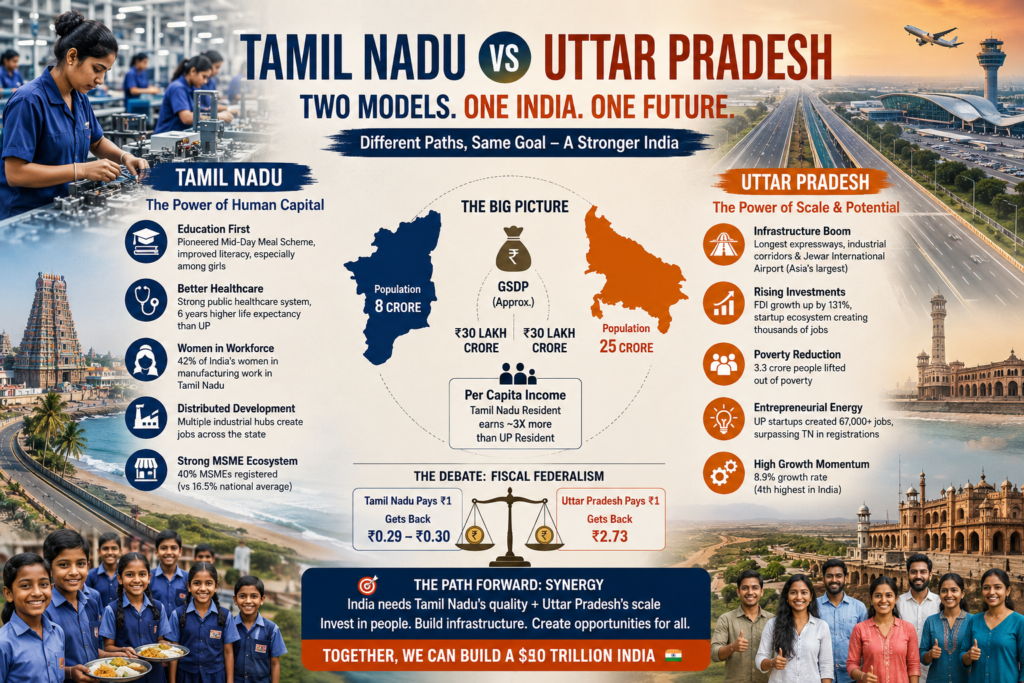
The result is striking: the average resident of Tamil Nadu is significantly wealthier than the average resident of Uttar Pradesh.
So how did two states that started from similar developmental challenges end up on such different economic trajectories? And what lessons can India learn from both?
A Look Back: The Story Begins in 1960
If someone had predicted India’s future economic leaders in 1960, most people would have placed their bets on Uttar Pradesh.
UP enjoyed the advantages of the fertile Gangetic plains, a large agricultural economy, and immense political influence. The state contributed roughly 15% of India’s GDP and was considered one of the country’s most powerful regions.
Tamil Nadu, meanwhile, faced a very different reality. Rural poverty was widespread, literacy levels were low, and natural resources were comparatively limited. Its share of India’s GDP stood at just 8.7%.
Yet over the next six decades, the script flipped dramatically.
Today, both states generate similar economic output, but Tamil Nadu achieves it with only one-third of UP’s population. The wealth gap between the average citizen in the two states has widened significantly, creating one of India’s most fascinating development stories.
The Turning Point: Investing in Human Capital
One of Tamil Nadu’s most influential decisions wasn’t the construction of a factory or a highway.
It was a school meal.
Long before India’s national Mid-Day Meal Scheme, Tamil Nadu introduced free meals in government schools. What appeared to be a welfare initiative became one of the state’s most powerful economic reforms.
Families had a strong incentive to send their children to school. School attendance rose, literacy improved, and more girls stayed in education for longer periods.
The long-term effects were transformative:
- Higher literacy rates
- Better employment opportunities
- Delayed marriages
- Lower fertility rates
- Improved household incomes
Economists often refer to this as the “demographic dividend.” Smaller, healthier, and better-educated families helped raise per capita income across generations.
Tamil Nadu’s growth story began not in industrial parks but in classrooms.
Healthcare: Building a Productive Workforce
Education alone wasn’t enough.
Tamil Nadu also invested heavily in public healthcare, creating systems that improved access to affordable medicines and primary healthcare services.
The state’s healthcare infrastructure became one of the strongest in India. Better maternal care, improved immunization rates, and stronger rural health networks helped raise life expectancy and workforce productivity.
The logic was simple:
Healthy people are more productive people.
By improving healthcare outcomes, Tamil Nadu created a workforce capable of supporting rapid industrialization and economic expansion.
The Silent Revolution: Women in the Workforce
Perhaps the most underappreciated factor behind Tamil Nadu’s economic success is the participation of women in manufacturing and industry.
The state has become one of India’s largest employers of women in factories, particularly in sectors such as:
- Electronics manufacturing
- Textiles and garments
- Automotive production
- Export-oriented industries
Government policies helped support this transition through safer transportation, working women’s hostels, skill-development programs, and workplace safety regulations.
When more women joined the workforce, household incomes increased, consumption expanded, and the economy gained a powerful growth engine.
The lesson is clear: economies grow faster when they fully utilize the talents of both men and women.
The Power of Distributed Development
Many successful Indian states rely heavily on a single superstar city.
Remove Mumbai from Maharashtra or Bengaluru from Karnataka, and much of the state’s economic output disappears.
Tamil Nadu chose a different path.
Instead of concentrating growth in one metropolitan area, it developed multiple industrial centers:
Chennai
India’s automobile and IT powerhouse, often called the “Detroit of India.”
Coimbatore
A leading engineering and manufacturing hub.
Tiruppur
One of the world’s most important textile export centers.
Hosur
A rapidly growing electric vehicle and advanced manufacturing cluster.
Madurai, Salem, and Tiruchirappalli
Emerging centers for industry, services, and logistics.
This distributed model created jobs closer to where people lived, reducing migration pressures and ensuring that economic growth spread across the state rather than remaining concentrated in one city.
Uttar Pradesh: The Rise of a New Economic Giant
While Tamil Nadu demonstrates the benefits of long-term investment in human capital, Uttar Pradesh is currently showcasing the power of scale.
Over the past decade, UP has undergone a remarkable transformation.
The state has invested heavily in:
- Expressways
- Freight corridors
- Industrial parks
- Airports
- Logistics infrastructure
Projects such as the Purvanchal Expressway, Bundelkhand Expressway, and Jewar International Airport are changing the state’s economic geography.
The results are beginning to show.
Foreign investment has increased, startup activity is expanding, and millions of people have moved out of poverty. Uttar Pradesh is increasingly positioning itself as a manufacturing and logistics hub for North India.
However, the state’s biggest challenge remains productivity.
Building roads is important, but sustained prosperity requires ensuring that those roads connect people to factories, jobs, skills, and opportunities.
The next chapter of UP’s growth story will depend on how effectively it converts infrastructure into higher per capita income.
The Debate Over Fiscal Federalism
The economic comparison between Tamil Nadu and Uttar Pradesh often leads to a larger debate about India’s fiscal structure.
Wealthier states argue that they contribute significantly more in taxes while receiving a smaller share back from the central government.
Less-developed states argue that national development requires wealth redistribution so that poorer regions can catch up.
Both perspectives have merit.
Tamil Nadu’s taxpayers expect recognition for decades of investment in education, healthcare, and industry.
At the same time, India’s development cannot be complete unless states such as Uttar Pradesh continue to improve living standards for hundreds of millions of people.
The challenge is finding a balance that rewards efficiency while supporting inclusive national growth.
What India Can Learn From Both States
The comparison between Tamil Nadu and Uttar Pradesh should not be viewed as a competition with a winner and a loser.
Instead, it represents two complementary models of development.
Tamil Nadu demonstrates the importance of:
- Education
- Healthcare
- Women’s participation
- Industrial diversification
- Regional balance
Uttar Pradesh demonstrates the importance of:
- Infrastructure
- Scale
- Logistics
- Market size
- Rapid economic expansion
India’s future may ultimately depend on combining the strengths of both approaches.
Imagine a state with Uttar Pradesh’s scale and Tamil Nadu’s human development indicators. Such a model could become one of the most powerful economic engines anywhere in the world.
Conclusion: The Road to a $10 Trillion Economy
India’s ambition to become a $10 trillion economy will require contributions from every state, but the experiences of Tamil Nadu and Uttar Pradesh offer particularly valuable lessons.
Tamil Nadu proves that investing in people creates lasting prosperity. Uttar Pradesh demonstrates how large-scale infrastructure can unlock enormous economic potential.
The real opportunity lies not in choosing one model over the other, but in blending them.
If Uttar Pradesh can successfully combine its infrastructure boom with stronger investments in education, healthcare, manufacturing, and workforce participation, it could become one of the most transformative economic stories of the 21st century.
And if that happens, India’s rise as a global economic superpower may arrive sooner than many expect.



Leave a Reply